September 5th, 2010 | 1 Comment »

Back in September 2008, I wrote in our newsletter:

By all accounts, Rosiek Sensei had a relationship with Tom “Doc” Walker Sensei, the much loved founder of Sand Drift Aikido in Cocoa, Florida. (Walker Sensei was instrumental in establishing the United States Aikido Federation in its early days). [A]ccording to Buck Pittman, our dojo in those days was called Sand Drift Aikido, presumably after Walker Sensei’s school.

And in October 2009 I wrote:

You may be surprised to learn that the founder of our school, Curtis Rosiek, was a student of Tom “Doc” Walker Sensei, the much loved founder of Sand Drift Aikido. In fact, Walker Sensei tested our earliest students.

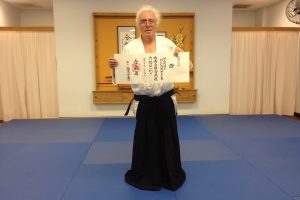
As it happens, I recently came across a 5th kyu certificate from 1993, from one of our earliest students. The certificate, issued by the United States Aikido Federation, confirms what I previously wrote.

Rosiek Sensei was in fact a student of “Doc” Walker Sensei, to the extent that the certificate identifies the school as Sand Drift Aikikai. (And therefore obviously connected to Walker Sensei’s school.) And although the certificate was signed by Rosiek Sensei, the test took place in Titusville, Florida, under Walker Sensei.

(Of course, at that time Walker Sensei was affiliated with the Federation.)

Tags: ,
Posted in Conversation
September 4th, 2010 | No Comments »

Next Saturday, September 11, we will be adding a beginner’s class to our training lineup. The class will run from 11:00 a.m. to 12:00 p.m., and will replace open mat.

We’ve had some good success with open mat lately, so if you’d like to see more open training times at the dojo, please let Sensei know.

Tags: ,
Posted in Announcements
July 15th, 2010 | 7 Comments »

Grady Lane Shidoin and Dee Seabolt SenseiGrady Lane Sensei of Brevard Aikikai is a dear friend personally, and with Peter Bernath Sensei, one of our seniors in Florida with whom the dojo has established an ongoing relationship. For our newer students, I thought I’d take a moment to make a brief introduction.

Lane Sensei was first introduced to the martial arts in 1972, when he began studying Karate. (He would subsequently earn a black belt.) He came to Aikido in 1975 after watching a class. At the time, Lane Sensei was unimpressed — he saw what he later described as an old man appearing to dance around a bit on the mat. Taking note, the Aikido instructor invited him to participate. With the bravado of youth, and confidence in his Karate skills, Lane Sensei accepted, and prepared for a quick match.

It was.

Within seconds, he found himself painfully pinned in a wrist lock. Lane Sensei immediately joined the class, thereby beginning an Aikido journey that would last more than thirty years.

Lane Sensei is currently ranked 6th dan, and is an Aikikai shidoin, or senior certified instructor. His black belt ranks were awarded by Yoshimitsu Yamada Sensei, 8th dan shihan and President of the United States Aikido Federation. He began his Aikido career under Dr. Tom Walker Sensei, 5th dan, and pioneer of Aikido in the United States.

Over the years, Lane Sensei has been a featured instructor at several dojos, including Sand Drift Aikido, Palm Beach Aikikai, and Aikido of Tampa Bay. We’ve been lucky to host Sensei on five occasions, most recently in July of last year. He also regularly appears to support our seminars, and is a familiar and welcome face at Aikido seminars in central and south Florida.

Dee encourages her students to seek out senior instructors in our Federation, to take advantage of the experience they offer. Lane Sensei has that experience in spades.

Tags: ,
Posted in Conversation
July 10th, 2010 | 5 Comments »

Editors Note: This is the third in a three part interview with Seabolt Sensei, chief instructor at the Aikido Center of Jacksonville. The full interview can be found under the Sensei tag.

Jerry: Let’s talk about your students. Since you became chief instructor, you’ve recommended several for black belt. Your thoughts?

Sensei: Actually, I’m really proud of that — that I’ve been able to contribute in some way to their progress.

Jerry: What about testing in general?

Sensei: What you have to remember is that with us, with any USAF dojo, our shihans test us for black belt. And our shihans were either students of the Founder, or have upwards of forty years experience. On top of that, our tests are only held a few times a year…in New York, Fort Lauderdale, Montreal. So they’re a big deal. You have hundreds of Aikidoka watching you at winter and summer camp.

Jerry: Tell me about the black belts the school has produced.

Sensei: Well, before me Chris tested for nidan through the school. And I was the first shodan who came up through the ranks. Earlier this year I was promoted to sandan.

After I started teaching, John tested for nidan. He was awarded his shodan by Clyde Takeguchi. Buck and you were the next two who came up through the ranks. And you’re the first who trained under me exclusively.

Oh, and Joel [Miller - Ed.] tested for shodan while he was with us. He’s at Austin Aikikai now. Also Tonya [Mochocki - Ed.] will test this year at the Christmas seminar in New York.

The Future

Jerry: What are your goals for the dojo?

Sensei: What I want, what I hope to do, is to spread Aikido in Jacksonville. I’d like our new dojo to be a center of Aikido here locally. I’m really proud of what all of us have built.

Also, I want to help bring along the next generation of Aikido students, again here in Jacksonville. Just like what happened to me, when I began teaching. We’re already seeing it in our school, the next wave, who are really dedicated. Some of them are even teaching. It’s exciting.

Jerry: Thank you, Sensei.

Posted in Conversation
July 9th, 2010 | Comments Off

Editors Note: This is the second in a three part interview with Seabolt Sensei, chief instructor at the Aikido Center of Jacksonville. The full interview can be found under the Sensei tag.

Jerry: Let’s talk a bit more about the early days. Why did you decide to move from the dance studio?

Sensei: Well, we left Mark Spivak’s [the dance studio - Ed.] because our training time was being cut. The space we rented was also being used by cheerleaders. They would stay during the evenings, which left less time for us.

Jerry: And then where did you go?

Sensei: We moved to the JCA [Jewish Community Alliance - Ed]. They were renting space to community groups.

Jerry: How did that work out?

Sensei: At first it was great — we had a really nice room. The problem was that when the JCA rented space for special events, we would always have to move. And the space we were moved to was really small. It became clear to us that it wasn’t working out.

Jerry: What did you do?

Sensei: Well, at that time I was getting my Masters in Psychology at UNF. I looked into organizing the school as a UNF club and moving there.

Chief Instructor

Jerry: Were you the chief instructor at that point?

Sensei: Yes.

Jerry: What was it like to take on that responsibility?

Sensei: [Laughs] It was a lot of work! When Chris moved, he left the school pretty disorganized. Little things, like a mailbox, our own phone number…these things weren’t really planned out. If we were to keep training, I would have to step up and put things in order.

One of the first things I did was make sure we stayed a USAF dojo. For me, it was never a question, but my fellow students didn’t have the experience I had going to seminars and training in New York. I had to convince them that it was important.

Jerry: At that point were you a student of Yamada Sensei?

Sensei: Yes, that happened when I first stayed in New York for five weeks.

Influences

Jerry: Who are your main influences?

Sensei: [Laughs] All my teachers!

I obviously owe a tremendous debt of gratitude to Yamada Sensei. And of course Sugano Sensei. I also owe a lot to my other teachers in New York, especially Donovan Waite, but also Steve Pimsler, Jane Ozeki, and Douglas Firestone.

And of course Peter and Penny Bernath, and Grady Lane. Grady especially has been a great help to me over the years.

Jerry: Who are your influences regarding your weapons training?

Sensei: I’d have to say I learned the most from seminars with Kanai Sensei and Claude Berthiaume. And of course Sugano Sensei’s classes in New York.

When Mike joined the school he also brought a lot of weapons experience, which was very helpful.

Jerry: You’re obviously grateful to your teachers. How important is it to receive this type of personal instruction?

Sensei: Very important. I’ve always believed that if you want to learn Aikido, if you’re serious, you have to put in your time with the shihans. You need to apprentice yourself, over a period of years. If that’s not possible, then you need to find an instructor who has that experience. And then you need to attend seminars. Lots of them. I’m a big proponent of seminars.

Jerry: Is that also your experience with weapons?

Sensei: Absolutely. With weapons there’s a lot of subtlety which you really can’t see unless it’s personally demonstrated. And again, you need this experience from a shihan or shidoin. When you’re receiving instruction from someone with thirty or forty years experience, over time it informs your technique a lot.

My job as an instructor is to bring these insights back to Jacksonville, to my students.

To Be Continued…

Posted in Conversation