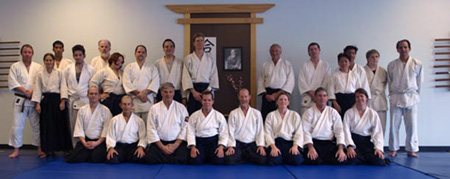
Over the years, I’ve noticed a tendency among Aikidoka to focus on differences, or the things that divide us. Whether those things are technique, pedagogy, or organizations, invariably the conclusion is: “Well, I’m sure that works for them, but it’s certainly not the way we would do it.” The implication, of course, is that the other way, the new way, (which in most cases isn’t really new at all, if only our friend had been paying attention in class), isn’t actually Aikido, or at least the Aikido our friend thinks he’s practicing.
That’s why I love training at other schools, with other instructors. Rather than focus on those “things”, I try (sometimes successfully, sometimes not) to focus on our commonality, or those principles which make our techniques work. It’s not the slight distinctions with ikkyo that matter, it’s the other things–positioning, distance, balance–that make the technique what it is. Sometimes we lose sight of this, to our real detriment.
And the connections don’t just stop there. All the dojos participating in our friendship seminar have real connections to each other. They may be obvious, as between our school, Brevard Aikikai and the Aiki O-Kami Society. Our connection there, of course, is Yamada Sensei.
Or they may be less obvious, but no less real. You may be surprised to learn that the founder of our school, Curtis Rosiek, was a student of Tom “Doc” Walker Sensei, the much loved founder of Sand Drift Aikido. In fact, Walker Sensei tested our earliest students. So our connection with Sand Drift is one of shared history.
And what about our friends at Shugenkai? Well, Woodard Sensei is a student of Kevin Jones Sensei, who studies under Maruyama Sensei. For years, Maruyama Sensei was a senior student of Koichi Tohei Sensei. Dee’s instructor, Yamada Sensei, although an uchi-deshi of O’Sensei, also counted Tohei Sensei as one of his instructors.
The connections are there, if we choose to look.
That seminar we had really was amazing!
I think training with a diverse of teachers; in and out of USAF; really improves our individual Aikido. In my very short career in Aikido I can already see where my influences are. The way I do one thing might be how Dee taught me,(Especially that soft ukemi.) likewise, I wouldn’t think about techniques as martial and realize there connection to sword work if it wasn’t for Jerry’s classes. Also, It had to have been the 400th time Buck told me “stay round and relaxed” before I got it; which has changed how I do every technique from that point on.
I think a student becomes a mosaic of who taught them, so the more influences we come in contact with the more complex our Aikido becomes… like a good curry. lol
Speaking of which, I need to figure out how Christina does her nikkyo. I’ve never felt a shomanuchi nikkyo that uses that level of pain compliance. More so I want to figure out how to survive it. So far my only reaction has been to take a break fall forward to get out of the pain, or to take a nose dive. lol
I don’t know if I ever would want to regularly practice a shomanuchi nikkyo with that extreme level of pain compliance just because the joint control and ballance taking is prettier looking 🙂 , but I think it would still be valuable to know how it is done.
Nikkyo is an interesting technique.
Coincidentally, I was speaking to Mike about it yesterday, regarding the mechanical aspects of the lock. I’m considering writing a post about it in the future. (But I want your posts also! Send ’em in!)
Regarding your comment about pain compliance, there is more than one way to successfully perform the technique. Rather than causing stress on the carpal bones and ligaments, which leads to that “shooting” pain we all experience, you can also perform nikkyo by upsetting uke’s “structure”. This relies more on balance taking as opposed to pain compliance and illustrates the similarities with ikkyo.
Regardless, pain compliance ought not be the goal of nikkyo (or yonkyo). Pressure points don’t always work, and the real study of Aikido is balance.
Having said that, your balance was being taken, MM. Training with her will help your ukemi.
Speaking of smiley faces, will Dee be at open mat, I want to practice some ukemi.
Yea, the way I learned to do shomanuchi nikkyo from you guys was mostly ballance taking on the cut and controlling the joints. I only feel pain taking ukemi for that if I try to fight and get up, or try to straighten my arm out.
Her shomanuchi nikkyo however is painful from the cut, it forces you straight to the ground or into a breakfall to escape the pain. You can’t stay off your belly from the moment she cuts, and it forces me to struggle to keep the bend in my arm if I do try to stay on my feet/knees.
I gave up trying to take the ukemi I was taught for that technique and just splatted or flipped out, it was too painful. Also me trying to maintain that bend in my arm was killing her tendentious in her thumbs. (Plus I’m not like an expert uke anyways, so I’m sure you or Dee would of found a prettier way to react to it. lol)
I’m going to try and figure out she preforms it for the sake of knowing, but you are right, you can’t rely on pain compliance alone. Plus, on the seldom occurrence when i get shomanuchi nikkyo right lol, I actually feel like i have a fair amount of control over my partner. The joints feel manipulated, the uke seems off ballance, and I feel like I can decide where they go. The pain compliance shomanuchi nikkyo felt like an entirely different technique all together from the uke’s side. Which is why I was trying to figure out how she was doing it… something I haven’t seen before. Similar to what I’ve seen, but some how VERY different. ??
Agreed, she was definitely giving me a lesson in ukemi.
dichotomy: Not sure about Dee. I’ll ask.
MM: I’ll have to feel the technique myself. Maybe I’ll learn something new!
How can you both be on the computer at the same time??
Computers have no dichotomy.
I enjoy getting different perspectives, all it does it widen your own knowledge and understanding of what works for YOU.
I for one have mixed feelings about pain compliance. For the purpose of MY training, i like to make sure uke feel’s it a little bit, but I’m not going to waste time trying to find that EXACT spot. I like the fact that pain compliance gives uke or in my case “the perpetrator” more incentive for moving where i want them to move, but I’m not going to strive for it. If I can control and take you down without it, then that works too.
I know an (unnamed) person on whom the pain compliance aspect of yonkyo *will not* work, even when performed by a *very* high ranking practitioner.
Heck, even my resistance to nikkyo has grown over the years.
Maybe increased flexibility in the joints and ligaments makes locks more bearable over time?… or maybe it is just the slow deterioration of nerve clusters? Either way, good times!
The former, I think. Yonkyo still hurts, though.
Instant carpal tunnel syndrome.
Hey, dichotomy. It’s past 3:00 p.m.
Your deadline, not mine. 😉
Sorry, I got held up at school. Check your e-mail before you go to bed.
He had to pick me up from work at 3pm
No worries, I was kidding. 🙂
Would you resend it to Sensei, though? My email is acting up.
Oh yeah I don’t remember if I emailed Dee, but I’m free any Saturday in November. It is mandatory I work Saturdays in December. My bad ^_^
Hi, I love the blog, but I’d like to point out a grammatical detail that’s been bugging me.
When you refer to Ueshiba Morihei as “Great Teacher” in Japanese, it is not correct to write O’Sensei (he wasn’t Irish, after all).
“Great Teacher” is composed of 2 kanji characters: the first is pronounced “dai” or “oh”/”oo” (background: http://thekanji.blogspot.com/2007/07/kanji-dai-big.html).
So if you want, write “Oh-Sensei” or “Oo-Sensei” or even ?sensei (bar on top of the O to indicate the length of the sound), but not “O’Sensei”.
To comment on the grammatical detail;
O’ Sensei is an English adaptation, which you can agree I’m sure.
With that stated, English is a phonetic language. Phonetic languages are unique in their presumptions. The have the presumption of phonetic variants. As “grey” and “gray” pronounce the same word. I off the top of my head can find about 4 more phonetic variants that will sound the strong “O” sound. According to my English education O’ is one of the phonetic variants for the strong “O”.
Quite the opposite, apostrophe is a mark of elision (http://en.wikipedia.org/wiki/Apostrophe), i.e., it shortens the prior syllable.
Thus, O’Sensei is shorto sensei.
It’s doing the opposite of what it should be.
Trust me on this, you should not be writing Oh-Sensei as O’Sensei.